

|
(alphabetized) |
 Gardening
Gardening
August Q&As–Bald Cypress Knees to Stinging Caterpillars
by Dr. William M. Johnson
Galveston County Extension Agent - Horticulture
August 24, 2005
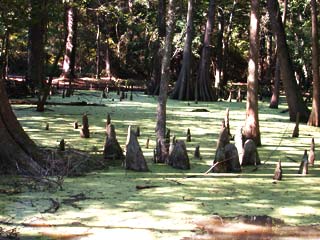 Although bald cypress trees are commonly associated with swamps and waterlogged
environments, they will grow very well in well-drained soils. Unfortunately,
some of our gumbo clay soils do not provide sufficient drainage to avoid
production of "knees."
Although bald cypress trees are commonly associated with swamps and waterlogged
environments, they will grow very well in well-drained soils. Unfortunately,
some of our gumbo clay soils do not provide sufficient drainage to avoid
production of "knees."
Photo by Herman Auer
Question: Do all bald cypress trees have knees?
Answer: "Knees" produced by bald cypress trees grown in the landscape is a symptom of over-watering and/or a soil with poor drainage. Although bald cypress trees are commonly associated with swamps and waterlogged environments, they will grow very well in well-drained soils.
Properly watered trees grown in a well-drained soil do not produce knees. Unfortunately, some of our gumbo clay soils do not provide sufficient drainage to avoid production of "knees."
Question: My family has always dusted vegetables rather than spraying them. Sometimes, unless it rains, the white dust residue will remain for weeks. How long are garden dusts effective?
Answer: Garden dusts are only effective for 5-7 days regardless of how long the actual dust particles applied remain visible. This is why it is so important to apply only a very thin–almost transparent–layer of dust when spraying.
If you pour it on, as many people do, after several applications you will have a "whitewashed" plant which can actually be damaged by the excessive accumulations. Such accumulations should be removed by washing before cooking or eating.
Question: How do I deal with all these sprouts coming up from the base of my crape myrtle trees? Can I spray something on them?
Answer: Forget using any weed killers. That will harm the overall tree. Trimming them off throughout the summer is the best way to slow them down. Prune the sprouts close to the trunk. Keep this up all summer and you will slowly win this battle.
Question: Several of my trees have low hanging branches that are in my way when I mow. Do I need to wait until winter to remove them?
Answer: Go ahead and remove the objectionable limbs. Summer pruning of small-diameter, low-hanging branches is safe. The important thing to remember is not to remove the branch collar which looks like a swollen area where the base of the limb enters the trunk. Also, make a clean cut.
I strongly recommend that all other major pruning activities be postponed until December through January while trees are in a state of dormancy. No painting of the pruned site is required or recommended.
Q: The leaves on my crape myrtles have a gray mold on them. Is this something I should be alarmed about?
A: This is one of the powdery mildew diseases and the most important disease of crape myrtles. It is the more serious in the spring and early summer. The growth of this fungus will coat the leaves causing them to be distorted and stunted. The flower buds will not open properly. Crape myrtles will vary in their resistance to this disease. You can reduce the severity of this disease by using a fungicide that is effective on powdery mildew. Effective fungicides include Immunox and Bayleton. To control this disease, make 2 to 3 applications 7-10 days apart.
Q: Is it true that some caterpillars can sting you like a hornet? If so, how do we know which ones to be on the lookout for?
A: Yes, there are several species of stinging caterpillars. However, most caterpillars are not poisonous. The stinging caterpillars have stiff poisonous hairs or spines on their bodies. The hairs or spines are connected to poison glands. When a person comes into contact with the spines, they break and venom is released.
Reaction to this venom varies from mild to severe. Small children can have severe reactions. Injury from these caterpillars is most common among children playing in yards and trees
There are several to be on the look out for. The puss or asp caterpillar is the worst. This one is covered in gray, brown or yellow hair. You cannot see the eyes or the legs. Puss caterpillars grow to about 1 inch in length, are teardrop-shaped. They resemble a tuft of cotton or fur due to their long, silky hairs.
The saddleback caterpillar is also very common. This one is very colorful and striking in appearance. It too is about 1 inch long and is pale green in color but with a purple or brown center that resembles a saddle on its back. Its sting is less severe than the puss.
The Io moth caterpillar is also around. It is about 2 inches long and pale green in color. It has a very striking set of stinging spines that would seem to say "Touch me and you’ll really regret it." However, the sting is relatively mild. These are the most common of the stinging caterpillars even though there are a few more.
Question: Is there any difference in taste or nutritive value between green peppers and those that mature and turn red?
Answer: Peppers that are allowed to mature and ripen entirely, from green
to yellow or red, are higher in vitamin content, especially Vitamin A. There
is little difference in taste although there is a considerable difference in
texture caused by the ripening process.
Dr. Johnson is a horticulturist with the Galveston County
Extension Office of Texas Cooperative Extension, Texas A&M University.
Visit his web site at http://aggie-horticulture.tamu.edu/galveston/index.htm
Gardening: Scale insects and pampas grass - July 17, 2004 article
Gardening: Bananas - August 1, 2004 article
Gardening: August Gardening Calendar - August 16, 2004 article
Gardening: Prepare Now For Fall Gardens - August 26, 2004 article
Gardening: September's Garden Calendar Includes Fall Pecan Field Day - September 2, 2004 article
Gardening: Ornamental Grasses - September 8, 2004 article
Gardening: Don't Let Landscape Become A High-Maintenance Nightmare - September 22, 2004 article
Gardening: Rose Propagation & Seasonal Decorating Workshops To Be Held - October 13, 2004 article
Gardening: November Is Pansy Time - November 6, 2004 article
Gardening: County Pecan Growers Display Their Successes - November 11, 2004 article
Gardening: Gardeners' Questions On Fall Crops - November 17, 2004 article
Gardening: Gardeners' Q&As For November - November 28, 2004 article
Gardening: Gardeners' December Checklist Includes Citrus Show On Dec. 9 - December 3, 2004 article
Gardening: Citrus Show A Huge Success With 185 Entries - December 19, 2004 article
Gardening: Trees and Shrubs - December 23, 2004 article
Gardening: Cold Weather Impact - January 4, 2005 article
Gardening:Announcing the 2005 Galveston County Master Gardener Training - January 13, 2005 article
Gardening:Peach & Plum Growers' Workshop To Be Held Saturday, January 29 - January 19, 2005 article
Gardening: Gardening for Texas Wildlife - January 28, 2005 article
Gardening: Extension Activities At The Home & Garden Show On Feb. 26-27 - February 23, 2005 article
Gardening: March Gardening Calendar Includes Seminar On Butterfly Gardening - March 2, 2005 article
Gardening: Gardeners' Q&As From The Galveston Home & Garden Show - March 10, 2005 article
Gardening: Program On Plumeria Offered On March 26- March 29, 2005 article
Gardening: Garden Checklist For April Includes Pecan Field Day - April 6, 2005 article
Gardening: Hints On Harvesting Vegetables For Peak Flavor - April 15, 2005 article
Gardening: Learn About Weed Control - April 27, 2005 article
Gardening: Home Gardening Chores and
May 14 Home Fruit Growers’ Tour - May 5, 2005 article
© 2004-2006
League City Area News Online.
All rights reserved.
Marilyn Clark.
League City Area News Online, P. O. Box 1693, League City, Texas 77574-1693
Please include your address and phone number for verification purposes.