

|
(alphabetized) |
 Gardening
Gardening
Gardeners Q&AS for August – Aliens can’t get credit for circles on rose leaves
by Dr. William M. Johnson
Galveston County Extension Agent - Horticulture
August 18, 2005
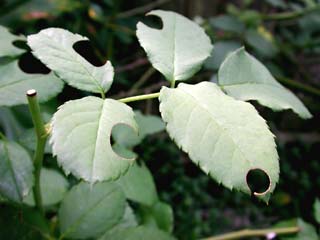 Aliens cannot be credited with causing neat circles to appear on leaves of roses
or bougainvillea. A solitary bee known as the leafcutter bee is the actual
culprit. Photo by William M. Johnson
Aliens cannot be credited with causing neat circles to appear on leaves of roses
or bougainvillea. A solitary bee known as the leafcutter bee is the actual
culprit. Photo by William M. Johnson
Question: What caused neat circles to appear on the leaves of my roses?
Answer: Neat circles in grain fields provide entertaining fodder for speculations, but I'm sorry to report that aliens can't get any credit on this intriguing occurrence on roses. Actually, this is the work of a solitary bee known as the leafcutter bee (Megachile sidalceae).
Leafcutter bees are small bees with black or gray bodies with white hair forming bands on the abdomen. Females cut out plant material from roses and other plants with smooth leaves including ash, redbud, etc. Bougainvillea leaves are also utilized. The female bee uses the leaf pieces to construct her nest which is about the diameter of a pencil and resembles a cigar. Favorite nest sites in urban areas range from hollow tree twigs to hollow tubes of lawn furniture to boring into urethane foam roofing material. Once the female has built her nest, she provisions each cell with a mixture of pollen and nectar (known as beebread). She then lays her egg on the food. The egg hatches into a tiny grub that consumes the food over the period of a week or two, and then pupates. Depending on the time of year and the species of bee, the newly emerged adult bees may fly out of the nest to start new nests, or may remain protected in the nest until the following spring.
Although unsightly, the damage leafcutter bees do to plants is typically cosmetic and will not kill the plant. No control is necessary. Bees are very important pollinators. Insects and animals pollinate more than 70 percent of crops that we rely on for food, fibers, and medicines and 90 percent of landscape flowering plants, shrubs, and trees. Bees foraging for nectar and pollen in the garden are harmless and will not sting unless provoked to do so.
Question: Why is the bark coming off my sycamore and crepe myrtles trees?
Answer: You do not have to be concerned about this. It’s a natural occurrence as sycamores and crape myrtles do shed their bark. It actually adds to the beauty of these trees and in fact horticulturists refer to this type of bark as exfoliating bark.Question: Can okra plants be pruned during late summer or early fall for additional production until the first killing frost?
Answer: Yes, but it might be best to simply make a midsummer planting instead of pruning off spring-seeded plants. When pruned, the plants will develop a bush rather than a single stalk which usually makes harvesting more difficult.
Pruning should be done 80 to 100 days before the first anticipated fall frost is anticipated allowing the plants time to produce additional pods.
Question: We have bought several new houseplants and put them on a table in our home. They are dripping water from their leaves all over the table. How can we stop this?
Answer: Often times, dripping plants are the result of a severe insect infestation from scales, aphids, or white flies. Their drippings are referred to as honeydew, which is sticky and sweet. But if this 'water' is actually coming out of the leaf, it is condition known as guttation.
Guttation occurs along the leaf margins as the result of water movement up a plant due to root pressure. The internal pumps within a plant will push water out of plants. It is a process to remove excess salts within a plant.
Since these plants are new, they are also likely to be succulent and well-fertilized and to have been growing rapidly. Avoid over-watering your new plants. I would also refrain from adding any fertilizer for several months. The guttation process will stop as the plants adjust to your home environment.
Question: I am harvesting hundreds of figs but the birds are harvesting thousands! How can I beat the bird's pecking the fruit?
Answer: To the delight of local fig growers and their friends and neighbors, the fig harvesting season is in full-swing. However, birds also share in that delight, and they have keen eyes and know exactly when the figs are ripe. They don't wait until the fig has softened and you had better not either.
Figs are ripe when they turn from green to brown. Granted, the fruit will get sweeter if allowed to remain on the tree longer but if the bird damage is too severe, you must harvest the figs as soon as possible.
When competing against our feathered friends, the best strategy is to get the fruit as soon as it is harvestable. Unfortunately, figs do not ripen further once harvested and will only keep a few days in the refrigerator.
The only surefire way to keep the birds off of the fruit is to cover the plants with bird netting which is available at various garden centers.
Question: Why are my squash bitter?
Answer: Bitterness in vegetables may be caused by variety of factors. Bitter cucumbers are caused by low soil moisture conditions during flowering. Bitter squash comes from plants that were grown too close together with other related cucurbits that have a bitter gene in them. Being grown near ornamental gourds is often the problem.
However, this happens at the breeder’s end or the seed producer. This does not happen in your garden because you planted squash beside cucumbers or pumpkins. Bitter squash has an unpleasant taste and can be harmful if eaten in sufficient quantities.
Just pull the offending plants up and start over. Remember this bitter gene was in the seed or plant you purchased, not something you did or the lack of rain.
Dr. Johnson is a horticulturist with the Galveston County
Extension Office of Texas Cooperative Extension, Texas A&M University.
Visit his web site at http://aggie-horticulture.tamu.edu/galveston/index.htm
Gardening: Scale insects and pampas grass - July 17, 2004 article
Gardening: Bananas - August 1, 2004 article
Gardening: August Gardening Calendar - August 16, 2004 article
Gardening: Prepare Now For Fall Gardens - August 26, 2004 article
Gardening: September's Garden Calendar Includes Fall Pecan Field Day - September 2, 2004 article
Gardening: Ornamental Grasses - September 8, 2004 article
Gardening: Don't Let Landscape Become A High-Maintenance Nightmare - September 22, 2004 article
Gardening: Rose Propagation & Seasonal Decorating Workshops To Be Held - October 13, 2004 article
Gardening: November Is Pansy Time - November 6, 2004 article
Gardening: County Pecan Growers Display Their Successes - November 11, 2004 article
Gardening: Gardeners' Questions On Fall Crops - November 17, 2004 article
Gardening: Gardeners' Q&As For November - November 28, 2004 article
Gardening: Gardeners' December Checklist Includes Citrus Show On Dec. 9 - December 3, 2004 article
Gardening: Citrus Show A Huge Success With 185 Entries - December 19, 2004 article
Gardening: Trees and Shrubs - December 23, 2004 article
Gardening: Cold Weather Impact - January 4, 2005 article
Gardening:Announcing the 2005 Galveston County Master Gardener Training - January 13, 2005 article
Gardening:Peach & Plum Growers' Workshop To Be Held Saturday, January 29 - January 19, 2005 article
Gardening: Gardening for Texas Wildlife - January 28, 2005 article
Gardening: Extension Activities At The Home & Garden Show On Feb. 26-27 - February 23, 2005 article
Gardening: March Gardening Calendar Includes Seminar On Butterfly Gardening - March 2, 2005 article
Gardening: Gardeners' Q&As From The Galveston Home & Garden Show - March 10, 2005 article
Gardening: Program On Plumeria Offered On March 26- March 29, 2005 article
Gardening: Garden Checklist For April Includes Pecan Field Day - April 6, 2005 article
Gardening: Hints On Harvesting Vegetables For Peak Flavor - April 15, 2005 article
Gardening: Learn About Weed Control - April 27, 2005 article
Gardening: Home Gardening Chores and
May 14 Home Fruit Growers’ Tour - May 5, 2005 article
© 2004-2006
League City Area News Online.
All rights reserved.
Marilyn Clark.
League City Area News Online, P. O. Box 1693, League City, Texas 77574-1693
Please include your address and phone number for verification purposes.