

|
(alphabetized) |
 Gardening
Gardening
Devil's Hair & Other July Gardening Q&As
by Dr. William M. Johnson
Galveston County Extension Agent - Horticulture
Submitted for July 20, 2005
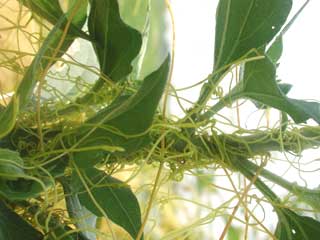 Several types of plants may serve as a host for dodder which grows into a tangled mat of thread-like stems that are bright yellow to bright orange in color. Dodder is also known by any of several other rather colorful names--including strangle weed, pull-down weed, devil's hair, love vine, hellbind, and hellweed.
Photo
credit: William M. Johnson
Several types of plants may serve as a host for dodder which grows into a tangled mat of thread-like stems that are bright yellow to bright orange in color. Dodder is also known by any of several other rather colorful names--including strangle weed, pull-down weed, devil's hair, love vine, hellbind, and hellweed.
Photo
credit: William M. Johnson
Upcoming Educational ProgramsWHAT:FALL VEGETABLE GARDENING WORKSHOP DATE: Saturday, July 30, 2005 TIME: 9:00-11:30 a.m. SEMINAR: Master Gardener Luke Stripling will present a workshop on growing vegetables in the fall garden. Topics will include bed preparation, soil fertility, types of vegetables, starting seeds, setting transplants, and disease and insect control. There will be a round-table discussion of what methods work in Galveston County. PLACE: Galveston County Extension Office, 5115 Highway 3, Dickinson REGISTRATION: No fee but seating is limited and reservations are required (281-534-3413, Ext. 6 or GALV3@wt.net) |
Answer: I've received several calls lately regarding a weed that truly fits the role of a "monster movie" character; and, where it occurs, it can be a really serious problem on various plants around the home. It can also be seen growing on plants in pastures and on some plants growing along highways. So, this week's column is a homeowner's "be alert" about this very unusual weed that has no leaves and is a true parasite. It is known as dodder.
Why do I label it as a "monster movie" character? Just the fact that it is also known by any of several other rather colorful names-including strangle weed, pull-down weed, devil's hair, love vine, hellbind, and hellweed-provides a definite clue. You can simply call it "trouble."
No matter what you call it, dodder is not only a weed, it is a true plant parasite which means it must depend entirely on other plants for its food supply. The darn thing even lacks true leaves-it is simply a vine that twines or coils around the stems and petioles of susceptible plants.
I would not rate dodder as very common problem in our growing area, but where it does occur, it can pose a very serious threat to various plants around the home. So, be alert about this very unique weed that has no leaves and is a true parasite.
Dodder obtains its food from its host plant by producing specialized root-like structures that grow into the host plant and thereby directly taps into the host plant's vascular system or "bloodstream." Once it gains a foothold, it soon forms a densely matted, hair-like growth. By the time dodder becomes noticeable, the thread-like stems are bright yellow to bright orange in color.
If dodder is a problem on your garden or landscape plants, read on to learn more about how to deal with this special pest. Even if dodder is not a problem now, it is good insurance to be well aware on how to identify it and how to deal with it early-once it is well-established in a site, you'll fully appreciate why one of its many names is hellbind.
This parasite is not picky about its host plants as it will parasitize a wide range of broadleaf plants in the home landscape including many perennials, flowering annuals, vegetables, and so on. Even the tough oleander can serve as a host. Where dodder is concerned, there is certainly no "honor code among weeds," as it also includes many types of broadleaf weeds on its list of fair game for food sources.
Since dodder is a true parasite and obtains all of its food directly from green plants, it generally does not kill its host plant. This would be logical, as Mr. Spock would surmise, because for dodder to totally wipe out the very thing that it is totally dependent upon would be suicide! However, affected plants are seriously weakened, stunted, and may even fall over. Over a single growing season, if several closely-spaced plants are parasitized, the plants in the center may be killed.
If left alone, infestations of dodder will continue to expand in size so long as there are suitable hosts to support its spread. Worse yet, the longer dodder is allowed to become well-established, the more difficult it is to control. You may have also noticed it on weeds growing along highways where it typically looks like patches of yellow-colored blankets often extending several feet in diameter. Dodder plants will start producing a profusion of white- to cream-colored flowers during late summer. In fact, the flowers produce an abundant supply of seeds which will germinate next spring and start the cycle all over. In such instances, dodder will continue to be a problem year after year because seeds remain viable for several years.
Control is somewhat relatively simple for the home gardener-you remove the host plant(s) affected along with the dodder (before flowering takes place) and dispose of it all by trash pickup. An exception is woody ornamentals such as oleander. If you get to it early enough on shrubs, you may be able to control dodder by removing only the area of shrub growth that is enmeshed with the stingy growth.
However, effective control can also be a little tricky as you must not leave any sections behind because any stem pieces left will start to produce new growth. Since sections of the vine are directly attached to the host plant, you just can't pull it off without leaving some sections behind.
The thing to keep in mind is that the earlier that dodder is controlled the better, since it will produce seeds that can be viable for years.
Question: My crape myrtles have been blooming really well this summer. My concern is that many of the branches on my crape myrtles really droop from the added weight of water after a heavy shower. A few branches have cracked. Should I prune the flowers back to reduce this weight?
Answer: Most crape myrtles are heavy laden with blooms that do droop when wet; this is especially so for those branches that grow laterally versus more erect-growing branches. If the stems are not strong enough to bear the added weight, they may snap off. One method to reduce weight is to clip off the flower clusters after they have bloom. This will also remove the newly forming seed pods and will induce production of more flowers.
Pruning old flowers is easy to do for trees that are small or with flower clusters in easy reach. Stems that are out of reach are just best left alone. This is also a good time to trim out any interior sprouts that have emerged from the roots and from around old pruning cuts. I would also remove any limbs that are drooping to the ground or brushing against the house.
Dr. Johnson is a horticulturist with the Galveston County
Extension Office of Texas Cooperative Extension, Texas A&M University.
Visit his web site at http://aggie-horticulture.tamu.edu/galveston/index.htm
Gardening: Scale insects and pampas grass - July 17, 2004 article
Gardening: Bananas - August 1, 2004 article
Gardening: August Gardening Calendar - August 16, 2004 article
Gardening: Prepare Now For Fall Gardens - August 26, 2004 article
Gardening: September’s Garden Calendar Includes Fall Pecan Field Day - September 2, 2004 article
Gardening: Ornamental Grasses - September 8, 2004 article
Gardening: Don't Let Landscape Become A High-Maintenance Nightmare - September 22, 2004 article
Gardening: Rose Propagation & Seasonal Decorating Workshops To Be Held - October 13, 2004 article
Gardening: November Is Pansy Time - November 6, 2004 article
Gardening: County Pecan Growers Display Their Successes - November 11, 2004 article
Gardening: Gardeners' Questions On Fall Crops - November 17, 2004 article
Gardening: Gardeners’ Q&As For November - November 28, 2004 article
Gardening: Gardeners' December Checklist Includes Citrus Show On Dec. 9 - December 3, 2004 article
Gardening: Citrus Show A Huge Success With 185 Entries - December 19, 2004 article
Gardening: Trees and Shrubs - December 23, 2004 article
Gardening: Cold Weather Impact - January 4, 2005 article
Gardening:Announcing the 2005 Galveston County Master Gardener Training - January 13, 2005 article
Gardening:Peach & Plum Growers' Workshop To Be Held Saturday, January 29 - January 19, 2005 article
Gardening: Gardening for Texas Wildlife - January 28, 2005 article
Gardening: Extension Activities At The Home & Garden Show On Feb. 26-27 - February 23, 2005 article
Gardening: March Gardening Calendar Includes Seminar On Butterfly Gardening - March 2, 2005 article
Gardening: Gardeners' Q&As From The Galveston Home & Garden Show - March 10, 2005 article
Gardening: Program On Plumeria Offered On March 26- March 29, 2005 article
Gardening: Garden Checklist For April Includes Pecan Field Day - April 6, 2005 article
Gardening: Hints On Harvesting Vegetables For Peak Flavor - April 15, 2005 article
Gardening: Learn About Weed Control - April 27, 2005 article
Gardening: Home Gardening Chores and
May 14 Home Fruit Growers’ Tour - May 5, 2005 article
© 2004-2006
League City Area News Online.
All rights reserved.
Marilyn Clark.
League City Area News Online, P. O. Box 1693, League City, Texas 77574-1693
Please include your address and phone number for verification purposes.