

|
(alphabetized) |
 Gardening
Gardening
Don't Be Your Plant's Worst Enemy
by Dr. William M. Johnson
Galveston County Extension Agent - Horticulture
July 13, 2005
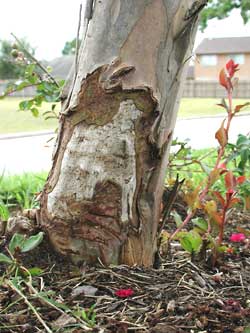 Many sickly, stunted trees that were planted years ago but haven't grown well have been damaged by improper use of string trimmers. Look at the base of their trunks, and you will often see scars and callus growth from repeated injury done to the base of the tree. Photo
credit: William M. Johnson
Many sickly, stunted trees that were planted years ago but haven't grown well have been damaged by improper use of string trimmers. Look at the base of their trunks, and you will often see scars and callus growth from repeated injury done to the base of the tree. Photo
credit: William M. Johnson
You can be one of your plants' worst enemies-unless you're cautious with mowers and string trimmers, avoid damaging roots and exercise care when using pesticides and fertilizers.
Avoid String Trimmer and Mower Damage
String trimmers that use a monofilament line for cutting down weeds and grass can be very damaging to young trees. String trimmers that use two monofilament lines typically are more powerful and can inflict greater damage.
Young trees have relatively thin bark. If the line is allowed to hit the trunk, part of the bark will be removed with each contact of the line. If you are not careful, you might even remove an entire ring of bark all the way around the trunk-thus girdling the tree.
Even more, mowers pushed hard or dragged around the base of young trees can be almost as damaging. To explain why this damage is such a problem, the part of a tree's "circulatory system" that carries food manufactured by the leaves downward to the roots (which can make no food for themselves) lies just under the bark.
Damage that occurs when string trimmers or mowers remove patches of bark interferes with the tree's ability to send food to its roots. As the roots are deprived of food, they become stunted and function poorly, and this leads to a stunted, unhealthy tree. If you remove a complete ring of bark, you may cut off food to the roots altogether, leading to the death of the plant.
In addition to interfering with food movement, the open wounds created by mowers and trimmers can provide entry points for disease organisms that can cause decay.
Many sickly, stunted trees that were planted years ago but haven't grown well have been damaged in this way. Look at the base of their trunks, and you will often see scars and callus growth from repeated injury done to the base of the tree.
To prevent these problems, do not allow grass to grow close to the base of young trees for the first three to five years after planting. Keep an area at least a foot out from the trunk free of grass. A mulch 2- or 3-inches thick spread evenly over the area, but pulled back slightly from the trunk, will help a lot.
Shrubs are generally planted in beds, so they are less at risk. But I have seen this problem occasionally when ground covers, such as Asiatic jasmine, are trimmed away from the base of shrubs with string trimmers.
Whether you maintain your landscape yourself or pay someone to do it for you, don't let this kind of needless damage happen to your trees and shrubs.
Don't Damage Roots
Trees also are vulnerable to root damage from construction and/or filling. If you plan on doing construction- whether building a new home, adding on to an existing one or even putting in a patio or repairing driveways or sidewalks-tree roots will likely be an issue.
Tree roots extend well beyond the reach of the branches, and most feeder roots (those that absorb the water and nutrients from the soil) are located in the upper 8 inches to 12 inches of the soil. This makes them much more vulnerable to damage than most people realize.
If you will be doing construction or filling around valuable existing trees, consider consulting with a licensed arborist before the work is done to make sure the trees are damaged as little as possible.
Be Careful With Pesticides and Fertilizers
Another way gardeners damage landscape plants is to use pesticides and fertilizers improperly. These products are useful and sometimes necessary in maintaining a healthy attractive landscape. But if they're misused, they can do more harm than good.
Pesticides commonly used in the landscape include insecticides (to control bugs and other insects), fungicides (to control diseases caused by fungal organisms) and herbicides (to control weeds). Landscape plants can be damaged by all three, but most damage occurs from insecticides, because we use them more often than other types, and herbicides, because they are designed to kill plants.
You can avoid damaging plants with pesticides by reading and following label directions carefully. I know the print can be very fine, but do like me and get out the magnifying glass if you need to. Without complete information on how to use a product, your efforts may be wasted, because applying the pesticide incorrectly does not control the pest, and you may even injure the plants you were trying to help.
Insecticides will list on their label which plants may be damaged by them and any temperature limitations (some insecticides will damage plants if applied during hot weather). Many insecticides also will burn or damage plants if you mix them too strong. You can see how important it is to know of these potential problems and avoid them by following label directions.
Since herbicides are designed to kill plants, we must be particularly careful when using them around desirable ornamentals. Again, read the label to make sure the herbicide will do the job you need it to do and to understand how to use it properly.
Many people also damage plants with fertilizers or plant food. Gardeners often think if a little is good, more is even better but fertilizers should never be applied stronger than label recommendations. You may apply less than is recommended, but mixing fertilizer stronger or applying more than is recommended on the label can lead to serious damage to your plants.
Practice being an ally to your landscape trees and shrubs-you will be rewarded with plants that are healthy and less of a burden on your pocketbook.
Dr. Johnson is a horticulturist with the Galveston County
Extension Office of Texas Cooperative Extension, Texas A&M University.
Visit his web site at http://aggie-horticulture.tamu.edu/galveston/index.htm
Gardening: Scale insects and pampas grass - July 17, 2004 article
Gardening: Bananas - August 1, 2004 article
Gardening: August Gardening Calendar - August 16, 2004 article
Gardening: Prepare Now For Fall Gardens - August 26, 2004 article
Gardening: September’s Garden Calendar Includes Fall Pecan Field Day - September 2, 2004 article
Gardening: Ornamental Grasses - September 8, 2004 article
Gardening: Don't Let Landscape Become A High-Maintenance Nightmare - September 22, 2004 article
Gardening: Rose Propagation & Seasonal Decorating Workshops To Be Held - October 13, 2004 article
Gardening: November Is Pansy Time - November 6, 2004 article
Gardening: County Pecan Growers Display Their Successes - November 11, 2004 article
Gardening: Gardeners' Questions On Fall Crops - November 17, 2004 article
Gardening: Gardeners’ Q&As For November - November 28, 2004 article
Gardening: Gardeners' December Checklist Includes Citrus Show On Dec. 9 - December 3, 2004 article
Gardening: Citrus Show A Huge Success With 185 Entries - December 19, 2004 article
Gardening: Trees and Shrubs - December 23, 2004 article
Gardening: Cold Weather Impact - January 4, 2005 article
Gardening:Announcing the 2005 Galveston County Master Gardener Training - January 13, 2005 article
Gardening:Peach & Plum Growers' Workshop To Be Held Saturday, January 29 - January 19, 2005 article
Gardening: Gardening for Texas Wildlife - January 28, 2005 article
Gardening: Extension Activities At The Home & Garden Show On Feb. 26-27 - February 23, 2005 article
Gardening: March Gardening Calendar Includes Seminar On Butterfly Gardening - March 2, 2005 article
Gardening: Gardeners' Q&As From The Galveston Home & Garden Show - March 10, 2005 article
Gardening: Program On Plumeria Offered On March 26- March 29, 2005 article
Gardening: Garden Checklist For April Includes Pecan Field Day - April 6, 2005 article
Gardening: Hints On Harvesting Vegetables For Peak Flavor - April 15, 2005 article
Gardening: Learn About Weed Control - April 27, 2005 article
Gardening: Home Gardening Chores and
May 14 Home Fruit Growers’ Tour - May 5, 2005 article
© 2004-2006
League City Area News Online.
All rights reserved.
Marilyn Clark.
League City Area News Online, P. O. Box 1693, League City, Texas 77574-1693
Please include your address and phone number for verification purposes.